












Μετάφραση 
Chania Old Town
Chania Old Town is the historic heart of the city and one of the most distinctive urban areas in Crete. Built around the remains of ancient Kydonia, it reflects the many cultures that shaped the city over the centuries, from the Minoans and Venetians to the Ottomans and the modern Cretan state.
The Old Town developed within the Venetian fortifications, parts of which are still visible today. At its centre is Kasteli Hill, a small elevated area next to the harbour that has been inhabited since Neolithic times. Archaeological remains from Minoan Kydonia can still be seen here, while the area also contains important buildings from the later history of Chania.
Splantzia
East of Kasteli lies Splantzia, the historic quarter that was mainly associated with the Muslim population during the Ottoman period. Today, its narrow streets, old houses and traditional tavernas give the neighbourhood a particularly atmospheric character.
The most important landmark here is the Church of Agios Nikolaos. During the Venetian period it belonged to the Dominican order, while under Ottoman rule it was converted into the city's main mosque. It became an Orthodox church in 1918. Around Splantzia Square are also the small Venetian church of Agios Rokkos and the churches of Agia Irini and Agioi Aikaterini and Ioannis the Hermit.
Venetian Harbour
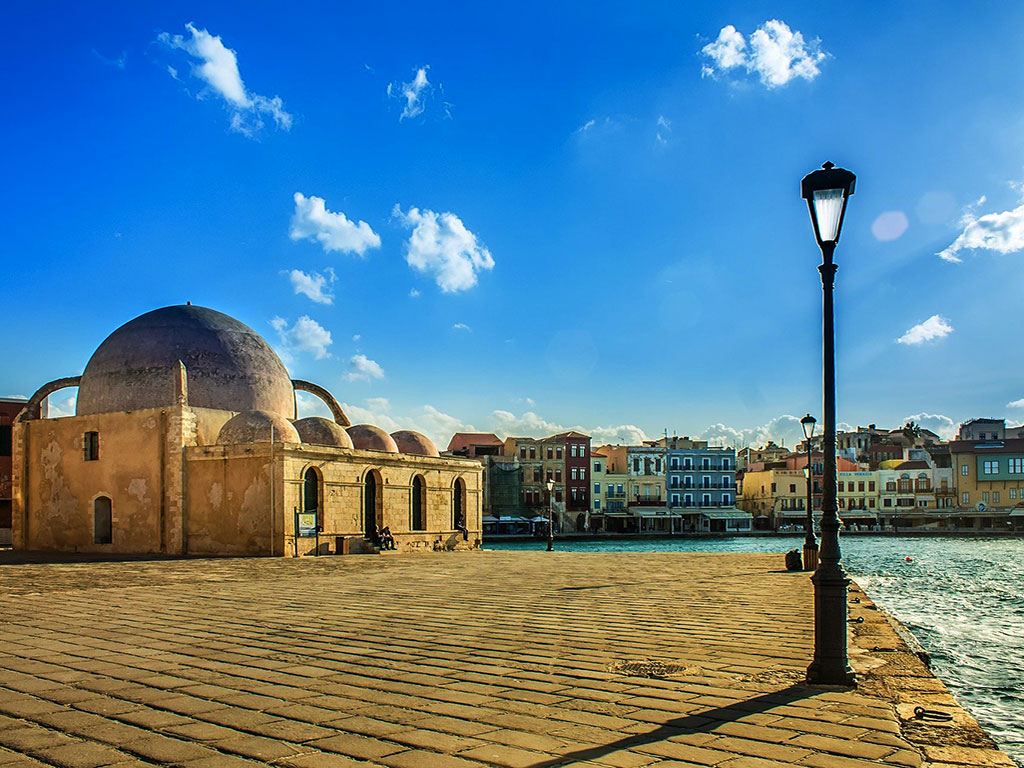
The Venetian Harbour is the most recognisable part of Chania Old Town. Its waterfront is lined with historic buildings, restaurants, cafés and shops, while the old harbour structures provide a reminder of the city's maritime past.
The Venetian Neoria were built for the construction and repair of Venetian galleys. Several of the original buildings survive, including Neorio Moro at the eastern end of the harbour, which now houses the Chania Sailing Club.
At the western end stands the Great Arsenal, one of the harbour's most important historic buildings. It now houses the Mediterranean Architecture Centre and is used for exhibitions and cultural events.
Syntrivani and the Old Town Streets
On the western side of Kasteli is Eleftherios Venizelos Square, commonly known as Syntrivani Square. It is one of the busiest meeting points in the Old Town and connects the harbour with the main streets of the historic centre.
From here, Halidon Street leads towards the Metropolitan Cathedral and the Archaeological Museum of Chania, housed in the former Venetian church of Agios Fragkiskos.
The surrounding streets are also known for traditional crafts. Stivanadika is associated with shops selling leather goods and traditional Cretan stivania boots, while nearby Machairadika is known for shops selling and making traditional Cretan knives.
Topanas and the Jewish Quarter
West of Kasteli are the historic districts of Topanas and the Jewish Quarter. Topanas was the main Christian and aristocratic quarter during the Ottoman period. Its name is derived from the Turkish Tophane, referring to the former ammunition stores in the area.
At the entrance to the old harbour stands Firkas Fortress, where the Greek flag was raised on 1 December 1913, marking the union of Crete with Greece. Today, the fortress houses the Maritime Museum of Crete.
Next to Topanas is the historic Jewish Quarter, where the Etz Hayyim Synagogue survives as an important reminder of Chania's Jewish heritage. The city's Jewish community was almost completely destroyed during the Second World War. The synagogue was restored and reopened in 1999.
The Lighthouse
The best-known landmark of Chania is perhaps the Chania Lighthouse, standing at the entrance to the Venetian Harbour. Although the lighthouse has Venetian origins, its present appearance dates mainly from the early 19th century, when it was rebuilt during the Egyptian period of Ottoman rule. Its distinctive minaret-like form makes it one of the most recognisable sights of the city.
A walk through Chania Old Town is the best way to appreciate its character. From Kasteli and Splantzia to the Venetian Harbour, Topanas and the lighthouse, the historic centre combines Venetian architecture, Ottoman influences, old churches, traditional workshops and waterfront buildings within a compact area that is easy to explore on foot.
